Our blog series “Coffee Break: 5 Minutes with…” is an opportunity to get to know our team members better.
Today, we’re getting to know our CTO (Chief Technology Officer) Gailius Kazlauskas Junior.
Although he officially joined the Via laurea team in 2018, Gailius has been contributing to the company way before that – during his university years, when he did summer internships here.
A fun question to start with – coffee or tea?
Coffee. During work, only black and without sugar. In my free time, I allow myself the pleasure of coffee with milk - if I feel I’ve earned that kind of indulgence. 😄
What does a great workday look like for you?
Most of the time, my day starts the evening before, when I plan the activities for the next day. At that point, I can already tell whether it’s going to be a good day based on my workload.
If, by the end of the day, the number of tasks hasn’t increased, then it’s a good day. And, if all planned tasks are completed without having to push anything to the next day, then in the evening - it’s “coffee with milk.”.
Why did you choose a career in the IT sector?
As far back as I can remember, I’ve always been something of an "explorer". I was always curious about how electronics work, how things perform their functions. It didn’t take long to realize that the foundation of all this lies in the IT field.
Then, of course, I discovered the internet and its vastness. I started tinkering with how websites work, how information travels between computers… until one day I found myself reading programming manuals written by university professors, even though I still had a few years of secondary school ahead of me before university.
It’s funny to remember how, without fully grasping the scope of the IT industry, I used to think: “Why aren’t more people programming? Then again, maybe that’s a good thing - there’ll be more programming left for me!”.
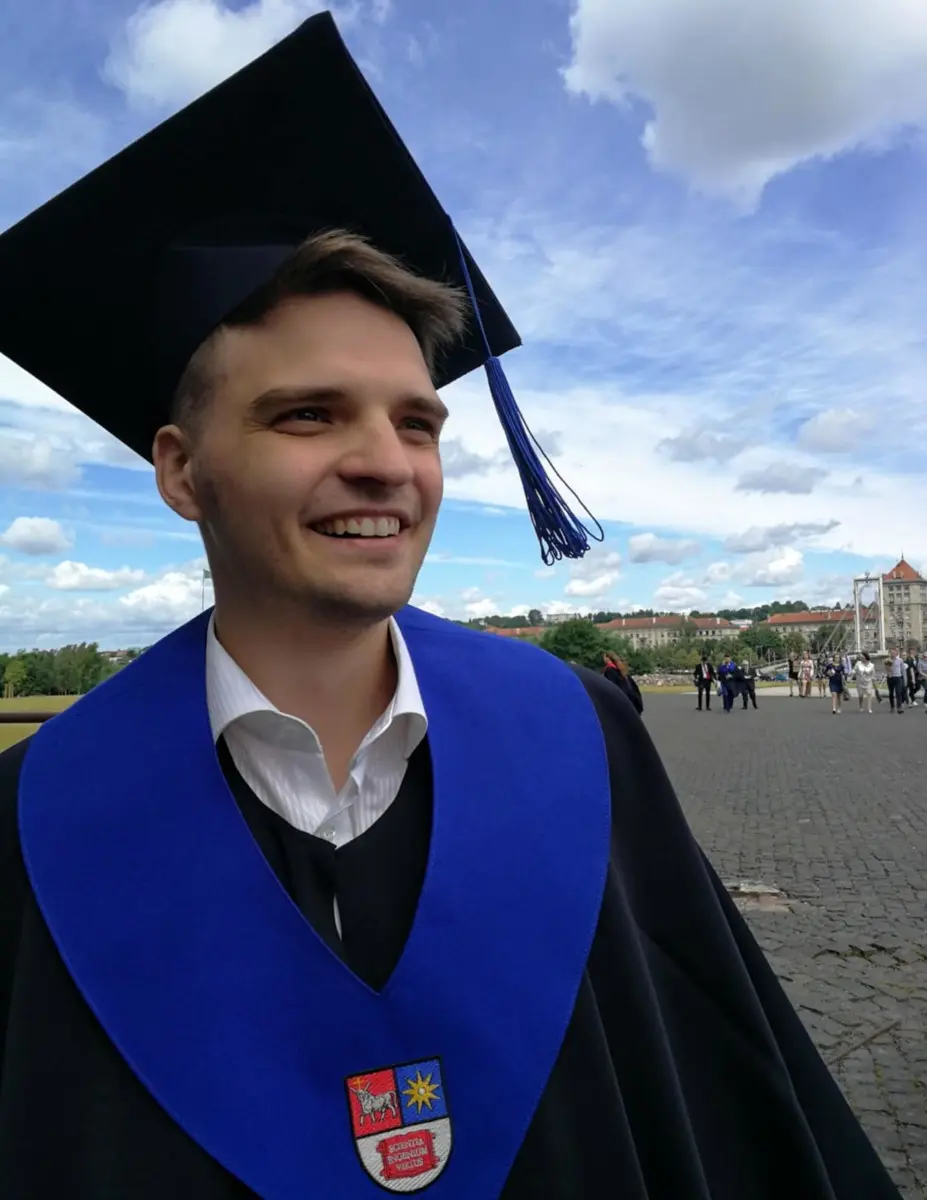
Kaunas Technology University graduation ceremony, 2018
It’s no secret that you’re the son of Via laurea’s CEO, Gailius Kazlauskas – how does that affect your work and personal relationship?
At first glance, working with your father and even sharing his name might seem fun, maybe even endearing. And yes, it does often bring smiles, and we frequently find ways to joke about it together.
However, behind the scenes, it’s not always entirely positive. Balancing professional and personal relationships isn’t easy. We both constantly have to remind ourselves that work-related disagreements shouldn’t spill over into our father-son relationship.
From the outside, it might seem unusual how we can be "arguing" over work matters and then, just a minute later, laughing in a completely informal way. That said, it can also be an advantage. We’re able to express our opinions to each other much more openly and confidently, fully understanding that, at the end of the day, we’re working toward the same goal, and that no disagreement will affect either our personal relationship or job security. In that sense, I believe we arrive at higher-quality decisions than we would in a typical employer-employee relationship.
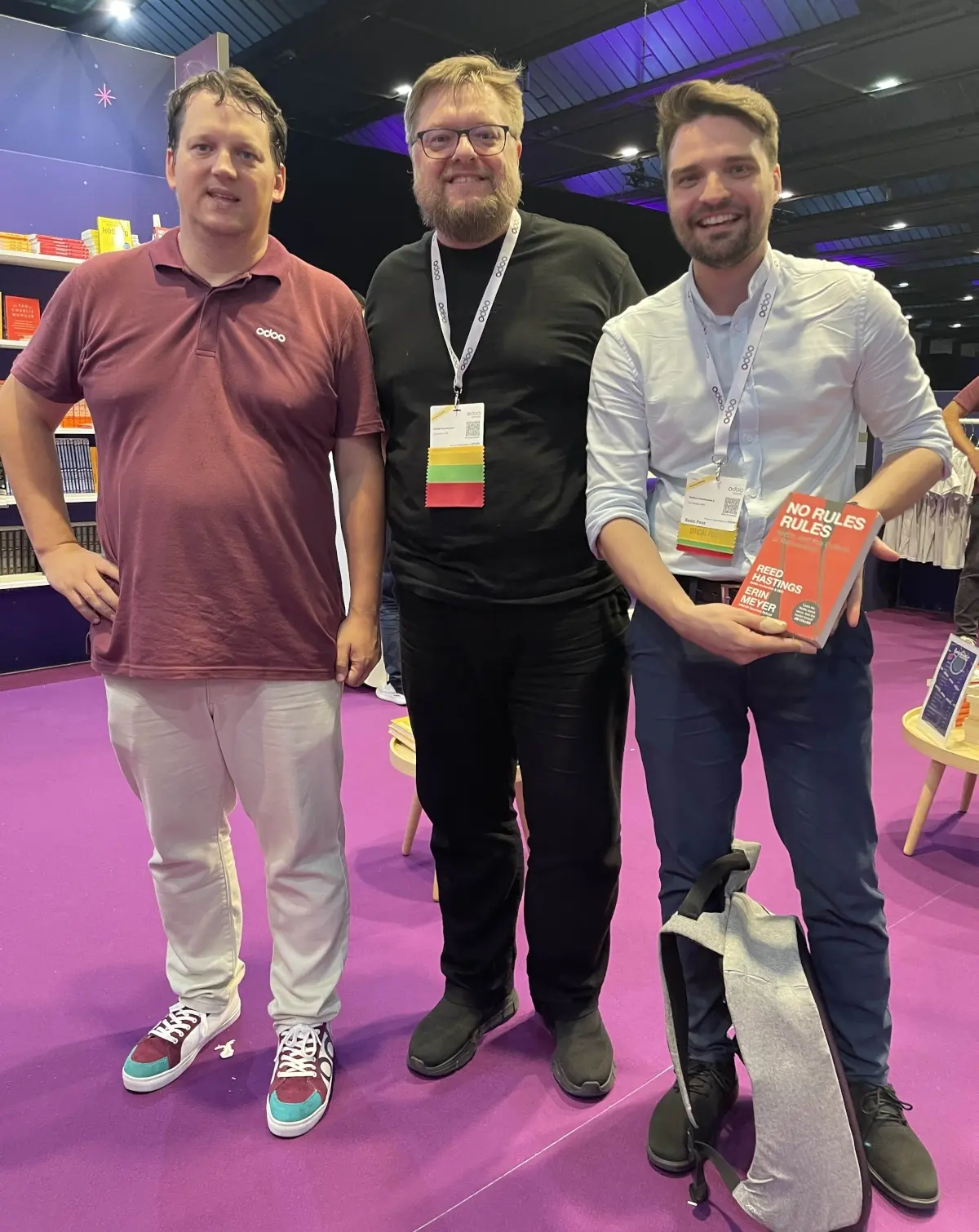
Gailius Jr. and Gailius Sr. with Fabien Pinckaers (Odoo founder)
At first, it was also difficult to get used to calling my father by his name, but referring to him as “dad” in a professional setting with colleagues or clients seemed like a bigger issue in terms of professionalism. Over time, a clear distinction naturally formed: at work, he’s the director - Gailius senior; at home, he’s - dad.
Sharing the same name also comes with its own pros and cons. Clients who aren’t aware of this can sometimes get confused as to how one moment it’s Gailius Sr, and the next, Gailius Jr. Still, it’s not a common name, so the likelihood of two people having the same “Gailius” is close to zero.
In your opinion, what sets Via laurea apart among Odoo partners?
Via laurea was probably among the earliest adopters of Odoo's methodology for partners. In particular, strictly adhering to the core principle - avoiding custom development as much as possible and, instead, encouraging clients, wherever feasible, to adapt their processes (often to objectively better ones) in line with Odoo.
What is the most common misconception about the Odoo ERP system?
In terms of functionality, Odoo can easily stand alongside other competitive ERP systems, yet its implementation and maintenance costs are significantly lower. This often leads clients to assume that the system is somehow inferior and that the end product won’t meet their expectations.
I believe Odoo frequently surprises clients with its capabilities. However, with this preconceived notion in mind, people still tend to look for “what’s the catch” and, of course, they manage to find areas where the system may fall short in one or another non-essential functionality.
When do ERP projects become particularly complex?
Complexity is most often driven by three “cardinal sins”:
- An excessive desire for system customization;
- The use of third-party modules;
- The client’s wish to manage the Odoo IT infrastructure themselves;
While all of this is, in principle, commendable and reflects the client’s involvement and initiative, it typically ends up making the partner’s work more difficult. From our side, system maintenance and quality assurance become significantly more challenging.
What trends in the ERP industry do you find most interesting today?
It’s probably no surprise that artificial intelligence (AI) is currently one of the most disruptive technologies across the entire IT landscape, including ERP systems.
At the moment, I’m closely following the development of so-called “agent-based” solutions. Ever since GPT-1, it was clear that the technology would evolve to where it is today, and with the release of GPT-3 and ChatGPT, we began to see early signs of the potential to transform, or even replace, certain aspects of the workforce with AI. Today, these “agents” are still far from perfect, and I believe we shouldn’t expect major breakthroughs just yet.
However, I do see a future where, within Odoo, we’ll simply create an employee profile for what is essentially an AI agent - one that performs the same tasks we handle today: communicating with clients, managing projects, generating sales and purchases, and more.
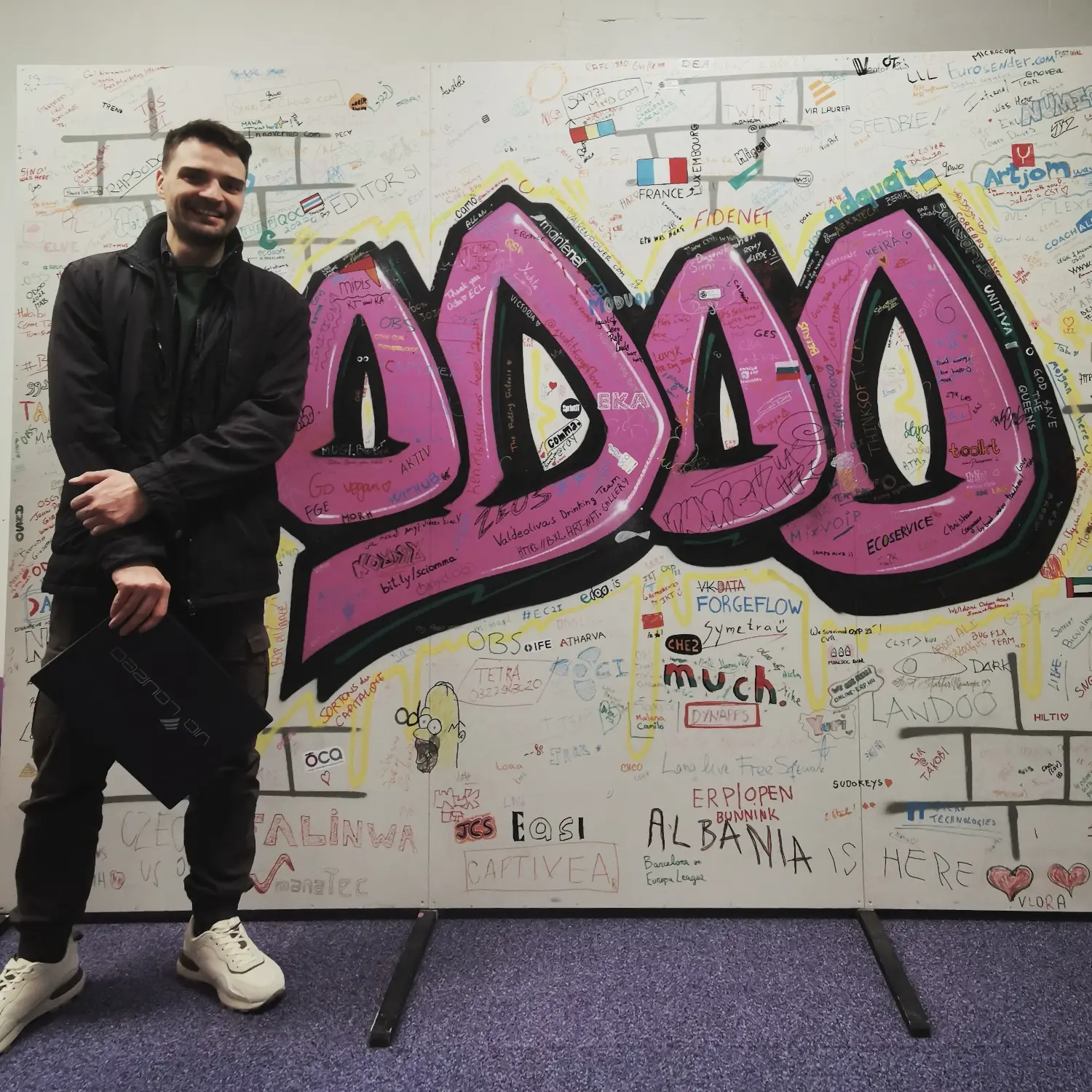
Odoo Partners Day event in Belgium, 2026
What qualities do you look for in your programming team?
In my view, one of the most important qualities in a programmer is critical thinking. It’s essential that a developer can approach any given problem by breaking it down into its fundamental components and ensuring the correctness of each part of the solution.
Beyond that, a programmer should be genuinely passionate about their field. When faced with a new problem, they shouldn’t be driven solely by the goal of moving a task to “Done,” but also by the opportunity to deepen their knowledge through the process of solving it.
To wrap up – what is the most important leadership lesson you’ve learned as the CTO of Via laurea?
When it comes specifically to leadership, rather than management, a leader, as the name itself suggests, must be at the forefront of what they expect from their team.
Interestingly, this wasn’t a typical lesson for me (where you start not knowing). Quite the opposite - I began on the right path, leading effectively, with my own drive motivating others, and in turn, the team’s curiosity and enthusiasm motivating me.
The real lesson came later, when, due to my growing share of other responsibilities across the company and with different teams, I had to distance myself from our development team. I spent less time with them, stopped programming and engaging in it. That’s when you start to feel a decline in ambition across the team, gradually replaced by apathy toward work - and that is like a disease spreading through the company.
