When searching for an HR management system for a company, you'll find dozens of different solutions available on the market – from employee recruitment management tools to HR accounting programs. Some solutions perform only one specific function, while others promise to cover all personnel management needs. But, the majority of HR platforms lack integrations with other programs used in the company.
Therefore, when choosing a personnel management system, it is worth looking a little broader than just the HR functionality. Over time, the most efficient and, often, the most cost-effective choice is one that grows along with the entire company, not just the HR department. And that is exactly the type of system we will discuss in this article.
What are personnel management systems and why are they needed?
A personnel management system (or HR system) is software designed to automate and centralise all processes related to employees: from candidate selection and onboarding to vacations, time tracking, and document management. Instead of having information scattered across Excel spreadsheets or paper documents, the personnel management program consolidates everything in one place – accessible to HR specialists, managers, and the employees themselves (based on set user permissions).
When does a company need an HR system?
Typically, companies start feeling the need for a personnel management system when the team is growing rapidly. While there are only a few people working in the company, HR processes can still be managed manually. However, when the number of employees grows, so does the number of vacation requests, contracts, evaluations, and other tasks, which become not only difficult but also risky to manage without an HR software.
For instance, you may notice that documents are increasingly getting lost, contracts are not renewed on time, important deadlines are missed… It is precisely then that companies start looking for a solution that would reduce the administrative burden and allow the HR team to spend more time on strategic rather than routine tasks.
What functions should a good HR program include?
There are various HR systems, from specialised personnel management programs that are focused on managing employee information, documents, and contracts, to personnel accounting programs, specifically designed for calculating salaries and benefits.
But, for a truly useful and long-term HR solution, the software's functionality should cover the entire employee lifecycle:
- Recruitment – The ability to post job vacancies, collect and evaluate applications, and manage all selection stages in one system.
- On-boarding – Automating the new employee adaptation process, organising necessary documents, equipment, training, and team introductions during the first weeks of work.
- Payroll and vacations – Accounting for working hours, overtime, and schedules, together with vacation and salary calculations.
- Performance evaluation and appraisals – Tools for periodic conversations, goal setting, and progress monitoring that help employees achieve growth within the company.
- Off-boarding – Managing the termination of employment, handover of tasks and information to other team members, removing access to company data, final paychecks, and communication.
The more necessary functions the HR system includes, the fewer additional, unrelated tools are needed, and the more consistent the entire personnel management process becomes.
Odoo ERP system – HR management and more
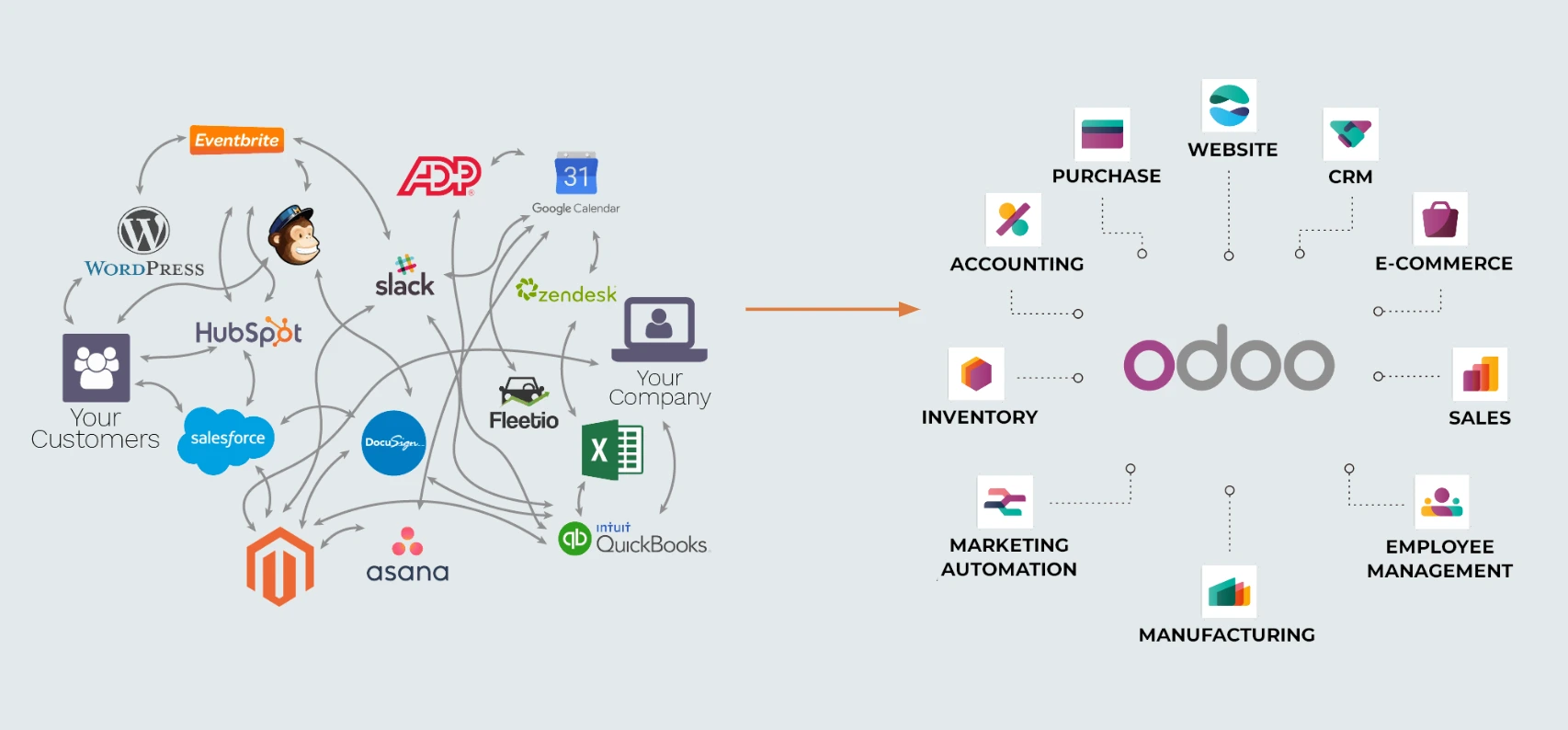
Odoo is a modular business management (ERP) system, consisting of numerous interconnected applications: from accounting and sales to warehouse management and manufacturing. One of these modules, of course, is employee management, which acts as a full-fledged HR system.
Odoo employee management functionality
- Management of candidates and the hiring process: posting job openings, collecting applications, tracking selection stages, and communicating with candidates, all from one system.
- Employee onboarding process management: automated onboarding plans with tasks, reminders, and assignment of responsible persons to help the new employee integrate into the team faster.
- Employee performance evaluation: management of goals, performance, and periodic evaluations, allowing for systematic monitoring of employee progress and planning further development.
- Data management (employee card): employee profiles, contacts, positions, competencies, department, contracts, and documents consolidated into one easily accessible employee card.
- Time tracking: tracking and monitoring working time, integrated with project, payroll, and approval processes.
- Vacation management: holidays and other absence requests and approvals, automatically reflected in work schedules and calendars.
- Employee expense management: registration, approval, and accounting of travel and other work-related expenses.
- Internal communication channel – communication of all departments happens directly in the system, where employees can view their data, submit requests, and receive company news.
However, unlike tools dedicated only to personnel management, Odoo is fully integrated with other departments and processes. This means that all company activities can be managed in one place, without creating team separation, and data travels automatically between departments, without the need to manually transfer from one software to another.
What else can be managed in the Odoo system?
Odoo is a business management system that integrates all necessary business functionality in one place. In addition to personnel management, it also offers:
- Sales management (CRM) – customer relationship management and lead / opportunity administration, creation of quotes, orders, and invoices, as well as progress tracking.
- Project management – creation and planning of tasks and projects, tracking statuses and deadlines, managing resources and team workloads.
- Accounting management – bookkeeping, payroll, government reporting, and tax administration.
- Purchasing management – supplier and purchase order management, automatic purchase proposals, budget planning and reports.
- Warehouse (inventory) management – inventory movement and counting, picking operations, MIN/MAX rules, and real-time dynamic reports.
- Manufacturing management – planned or automatic production orders, full product traceability, automated raw material orders, and quality control.
- Marketing campaigns – email and SMS campaigns, social media management, event planning and administration, marketing automation.
- POS system – essential cash register functions, marketing tools (discounts, gift cards, etc.), real-time interface with sales and inventory.
What is the benefit of integrating all company processes in one place?
In practice, the integration between the human resource management system and other business processes allows for the automation and optimisation of many business operations. For example, an employee working on different projects and tasks, regardless of their department, can easily log their working time by simply starting and stopping the timer in the system. This time is then immediately reflected in the accounting module and reports, so there is no need to enter anything manually.
Thanks to integration, processes become much more efficient, and employee productivity increases, as less time is wasted on manual work. Also, when all information between departments travels automatically and in real time, the likelihood of errors and duplicate data significantly decreases. Meanwhile, managers see the entire company picture in one place, allowing them to make better-informed business decisions.
Moreover, a single business management system is usually a more cost-effective solution than having many single-purpose systems, as each new program requires separate licenses, installation, support, etc. With Odoo, all standard modules are already included in the license price, including the HR program.
Who is the Odoo business management system suitable for?
The open-source system Odoo is extremely flexible, making it suitable for companies of various sizes and industries.
Small and medium-sized enterprises can start with the most important solutions for them, gradually expanding the system's functionality as needs change. Meanwhile, large organisations, including corporate groups, can fully integrate all their processes in one place and adapt Odoo's functionality to their unique processes.
When it comes to industries, Odoo can also be adapted to various sectors, including manufacturing, retail and wholesale trade, project-based services, logistics and warehousing, construction, agriculture, educational institutions, and more.
Currently, Odoo has over 28 million users worldwide, including well-known global brands, such as Toyota and Danone.
When it comes to industries, Odoo can also be adapted to various sectors, including manufacturing, retail and wholesale trade, project-based services, logistics and warehousing, construction, agriculture, educational institutions, and more.
Currently, Odoo has over 28 million users worldwide, including well-known global brands, such as Toyota and Danone.
Wondering if Odoo would work for your business?
If you're looking for a human resource management system that grows with your business and integrates not only HR management but also other company processes, we invite you to a free Odoo consultation.
Via laurea is an official, certified Odoo partner in Lithuania, providing Odoo implementation, development, maintenance, and support services. We've also developed a set of Lithuanian accounting modules in the Odoo system, which is compliant with lithuanian accounting and payroll standards.
Here is what our process looks like:
1. During the first consultation, we will get to know your company and discuss your specific needs.
2. Next, we'll ask you to fill out a pain point analysis document and industry-specific questionnaire.
3. After analysing the information you provided, we will present a preliminary commercial offer.
4. If our proposed solutions and budget meet your expectations, we will prepare a personalised Odoo DEMO presentation that will allow you to see how Odoo meets your needs.
5. Upon agreeing on your key priorities and project scope, we sign the final contract and get started!
Choose the most suitable date and time for your first consultation here:
Book a consultation
